
Our heat pump is probably the number one thing I’m asked about from friends, so I’ll try to go into a bit of detail on our experience. And for those who know that our house is still too cold in the winter, let’s call this post “the story of why our house is cold.” 🙂
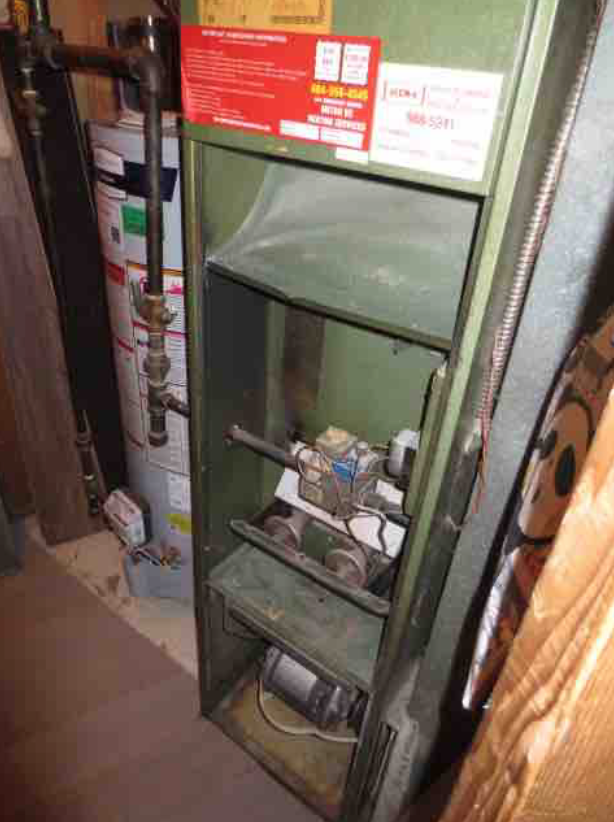
The original house was heated primarily by a gas furnace, with electric baseboards in the areas that were added on. And, the gas furnace was original from the early 1960’s! While the previous owner insisted that it still “worked great,” I couldn’t bring myself to use it another year because (1) being 60+ years old it could fail at any time, and (2) I would not be able to sleep at night knowing how much gas (and greenhouse gas emissions) I’d be wasting with our terribly insulated, extremely air leaky house. (And as it turned out, the electric baseboards also had to come out because they were on walls with asbestos.)
And so, my second call before we took possession of the house (after the asbestos contractor) was to a mechanical contractor to get a quote for a heat pump. I knew that I wanted the Mitsubishi air source heat pump – it’s reliable and does not need secondary backup heating.
Heat pumps effectively “move” heat from outside to inside (in heating mode) or inside to outside (in cooling mode). (One of the big benefits of getting a heat pump is that they do both heating and cooling, so you don’t need a separate air conditioner. We didn’t have cooling to begin with so were happy to be getting it with our new heat pump.) Our Mitsubishi heat pump has an outdoor unit and a few options we had to chose from on indoor units.

For a house with a central furnace it *can be easy* to replace the furnace with a heat pump and an air handling unit (basically a box with a fan that distributes warm or cool air through the existing ductwork, as a furnace fan would do). So this is one thing we did.
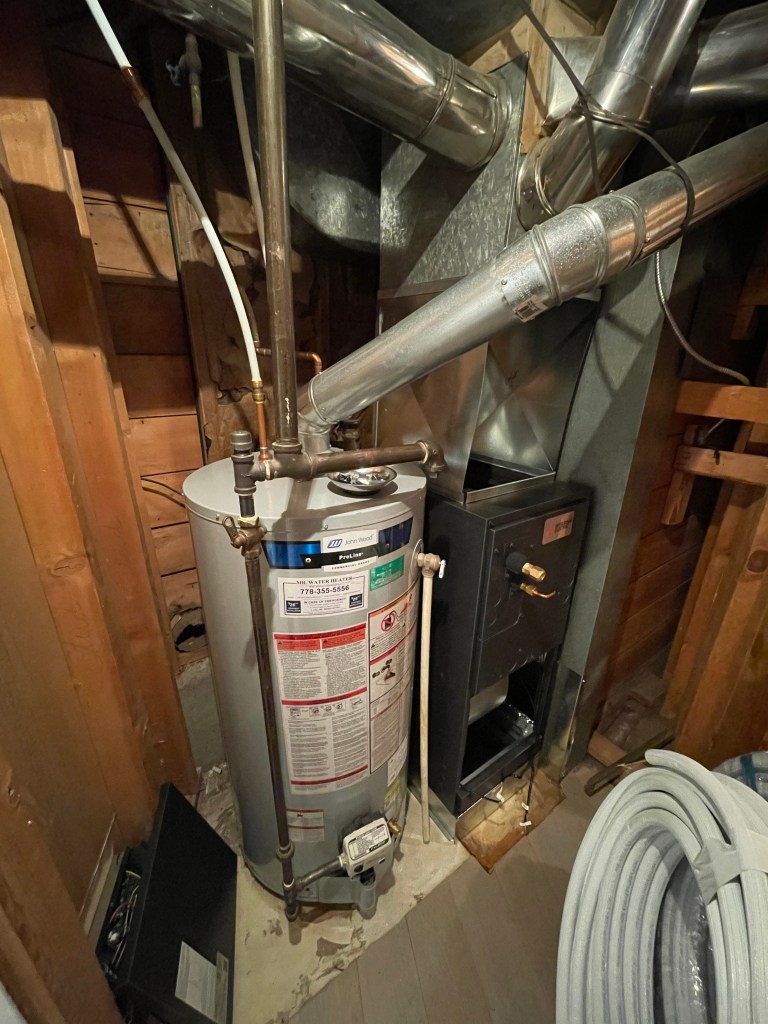
I say *can be easy* with asterisks because one of the changes that comes with using heat pump technology is that they supply air (in our case) at a lower temperature than a furnace does – still warm air, but not as warm as a gas furnace would supply. This means that using the same ducting with a new heat pump and air handling unit will result in less heat being delivered to the rooms. This might be fine if the distribution was over-sized to begin with, or if the house’s building enclosure has been improved (like better insulated windows and air sealing). But in a house like ours where the ducting is already under-sized because of the additions, and the building enclosure is original (very poorly insulated and air leaky), we knew that the heat pump would not be able to supply enough heat through the existing ductwork to keep us warm.
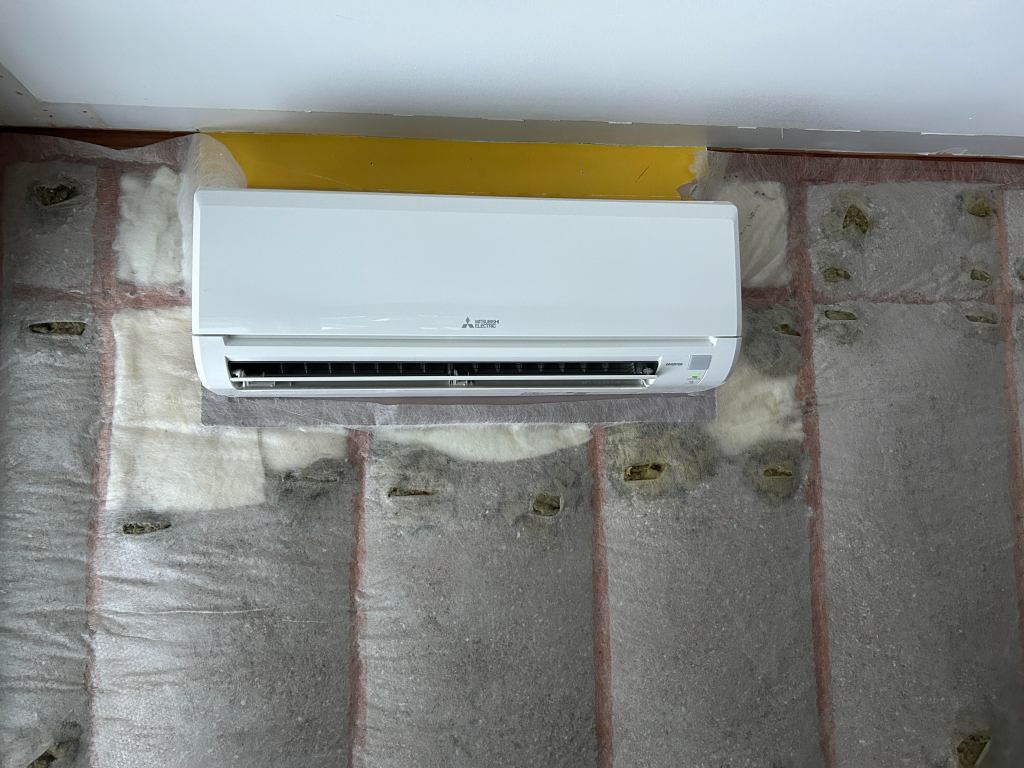
One solution to this is to use “heads”, which are indoor units that heat or cool a specific room. They connect to a multi-zone heat pump that supplies heating or cooling to both the central air handling unit and any heads in the house. They have their own temperature control so can be set to keep the specific room comfortable. The downside of these is that they add cost and don’t look great in my opinion (there are nicer-looking models that just look like a vent in the ceiling, but they’re more expensive).
Both contractors that we talked to recommended three heads – downstairs at the back of the rec room, upstairs at the kitchen/dining area, and upstairs in the master bedroom. The first two areas had additions that made the existing ducting under-sized, and the master bedroom was an addition that did not have any ducting (and we removed the electric baseboards in these areas due to aforementioned asbestos).
I really wanted to avoid heads – both to save money (they were roughly an additional $5k each) and to avoid having ugly boxes on the wall. And because we are planning to make our house much more energy efficient, I was confident that we wouldn’t need them after all of our renovations were done. (Actually, I did a quick HOT2000 model to confirm that we definitely wouldn’t need them.) That said, the master bedroom would be challenging because it didn’t have ducting. We debated whether we could get ducts there given our plans to demo the basement in the future, but it was still uncertain so we opted to put a head in the master bedroom.
So, we knew that the main living area (and therefore the entire house really) would not get enough heat until we insulated and air sealed. We decided we could live with this for a couple of years and rely on space heaters and sweaters.
And let me be clear: We made an informed decision to go ahead with an undersized system that would work with our long term plan. I don’t want to give the impression that heat pumps don’t work! They do need to be designed as part of a full system (heat pump and distribution) specific to the house. But the technology itself is fantastic, and replacing a gas furnace with an electric heat pump is one of the best ways to reduce greenhouse gas emissions from a house in places with a low-carbon electric grid (alongside replacing a gas hot water system with a heat pump water heater). And the proof that they work, for our house, is that when we close the door to our master bedroom, the indoor unit keeps it warm even in below zero weather.
Heat pumps are not cheap, but fortunately there are rebates that help with the cost (though they are disappearing as heat pumps become more common – the federal and municipal rebates that we got are no longer available, but the provincial rebate is still available). Our heat pump cost $29k all together, and we got $13k back in incentives. So, our heat pump net cost was about $16k or $5/sf for our house. Still a lot of money but considering this replaced a furnace that needed replacing and gave us cooling, not too bad.
How cold has it been? To be honest, the first winter was pretty rough – what little insulation our house had was gone in half of our walls due to the asbestos removal, leaving shiplap sheathing with large holes and air gaps so big that you could see outside in many places. We still had our single glazed windows with even more air gaps around the operable units. We were basically living outside that year! We had one weekend where the temperature went down to -12°C outside, and our thermostat read 9°C. That was the worst stretch; for the most part it stayed around 15°C, and we moved our space heaters around with us to keep warm.

This year is our second winter. We’ve made some big improvements (spoiler alert: new windows!) and it’s definitely better than last year – during the coldest periods we’ve kept it around 17°C with two space heaters running, a big improvement from 9°C! But we still have a lot to do, and the problem with insulating half of your house is that heat takes the path of least resistance as it tries to escape to the cold outdoors. This means that it bypasses our fancy new windows and we get more heat loss through the uninsulated/leaky areas, so it won’t be fully comfortable until we finish insulating and sealing the whole house.
Good motivation to keep working on the reno’s!

 Raincoast Renovation